
West Bank settlers expand control as military closures displace Palestinian farmers
New data reveals that farm outposts now control 18 percent of the West Bank, with military closures increasingly used to block Palestinian access to land while allowing settler expansion.
By Naomi Wood ·
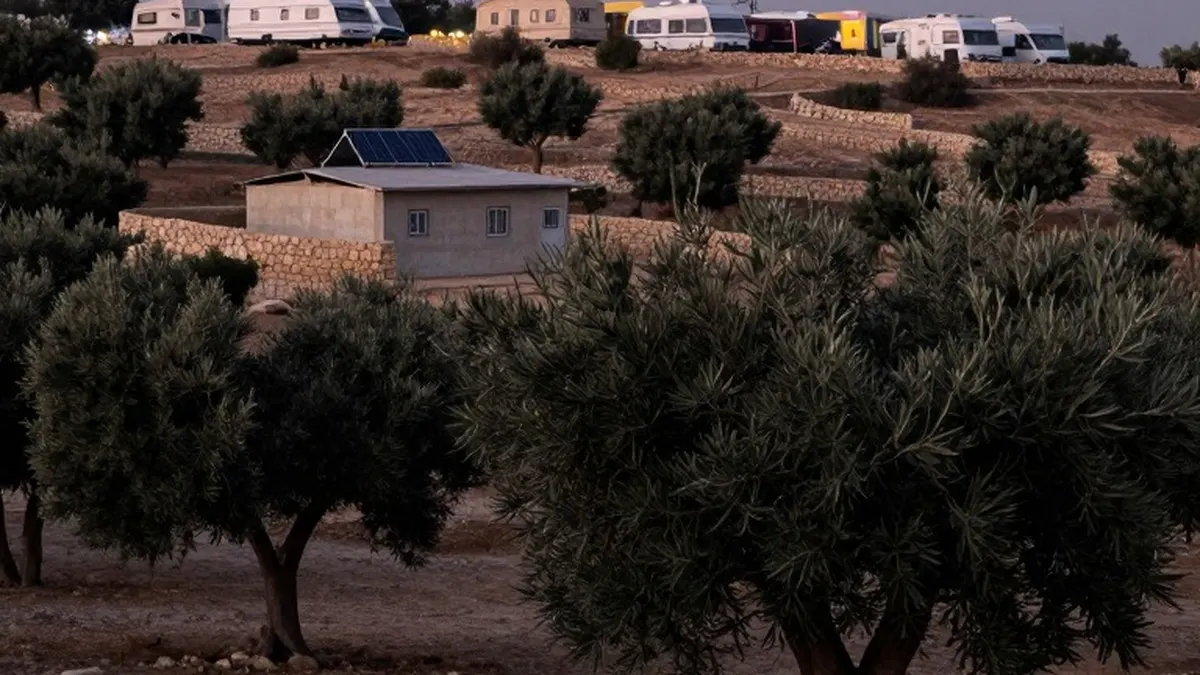
In the village of Deir Abu Mishal, west of Ramallah, residents report that their ancestral farmland has become effectively inaccessible due to the rise of settler outposts. Saleh Zahran, 39, described how his family, which inherits land containing 120 olive trees, has been unable to reach their property since a new outpost was established nearby in June. He noted that while the land is technically under joint Israeli and Palestinian control, settlers have attacked vehicles and used pepper spray to prevent access, leaving the family unable to harvest or maintain the site.
A recent decision by the Israeli High Court granted the village a brief window for coordinated harvesting in November. However, the experience was marked by conflict and restriction. During the first day of the allowed window, a group of settlers attacked the farmers, damaging their vehicles, while the army was not present. On the second day, with military liaison offices on site, farmers were limited to a small portion of the land and forced to leave by early afternoon. Zahran found that his farm room had been looted and his restored wells were being used by settlers for their livestock.
Legal experts argue that these events highlight a broader pattern of selective enforcement. Wail Qut, a lawyer for the Jerusalem Legal Aid and Human Rights Center, stated that while areas are often declared closed military zones to keep settlers out, the closures are frequently applied to prevent Palestinian owners from accessing their own land. This discrepancy allows outposts to grow and consolidate control over territory that remains legally disputed or owned by Palestinians.
Data from Kerem Navot and Peace Now indicates the scale of this expansion. As of the end of 2025, farm outposts controlled more than one million dunams, which is approximately 18 percent of the West Bank. This represents a significant increase, with roughly 750,000 dunams taken since late 2022. Dror Etkes, founder of Kerem Navot, explained that once an area is closed to Palestinian access, settlers typically move in to take over the land, a process that has become a de facto policy.
Similar dynamics are observed in other communities such as Madama and al-Mughayyir. In Madama, the army gated the main road to the northern land five years ago, citing security concerns. Although the High Court dismissed a petition against the closure, allowing farmers to walk to the land, the practical effect was a complete blockage. When a settler outpost appeared in that closed area last April, the gate was reopened for settlers while villagers continued to face restrictions and armed threats.
In al-Mughayyir, located at the northeastern edge of the Ramallah governorate, about 80 percent of the village's land lies within closed zones. Village council member Samir Abu Alia described a recent incident where a wedding was interrupted by a military raid following a settler's complaint. Soldiers surrounded the venue and used stun grenades, leading to the temporary detention and beating of the groom. The village has seen significant expansion of settler outposts on the eastern plain since 2018, with one site growing from 200 dunams to 5,000 dunams.
The enforcement of these closures often appears inconsistent, particularly regarding the treatment of settlers. Documents from the Israeli NGO Yesh Din show that while closure orders technically apply to everyone, including settlers, they are primarily enforced against Palestinian owners. Lior Zur, a lawyer for Yesh Din, stated that this selective approach allows the military to transfer possession of land from lawful owners to settler trespassers. In one case, when the army declined to enforce a closure against settlers, it referred the legal objection to the Defense Ministry, a move the NGO described as an effort to shift responsibility.
This pattern is widespread across the West Bank, affecting villages such as Duma, Burin, and Taybeh. In Burin, for example, farmland in closed zones has seen five greenhouses destroyed by settlers. In Duma, a closure was enforced against Israeli solidarity activists protecting Bedouin families, allowing settlers to displace the community the following day. Yair Dvir, spokesperson for B'Tselem, noted that military orders and settler takeovers are complementary practices, with the army driving Palestinians off their land while allowing settlers to remain or establish new outposts.
The cumulative effect has been a sharp increase in violence and access restrictions during the olive harvest season. The United Nations Humanitarian Country Team reported on November 20 that more than 400 settler attacks causing casualties or damage had been recorded since September, a figure higher than any previous season. Etkes described the current situation as an implemented policy where outposts, though not legally formalized, are fully supported by the military and government. The result is a landscape where Palestinian families like Zahran's are left with rotting olives and limited access to their heritage, living what he calls the height of injustice.